New York Baked Cheesecake
Dense, tall and creamy, on a buttery biscuit base, baked in a water bath.
 Loved this recipe?
The Baking Cookbook, 100 recipes
Every ingredient in cups and grams, with a photo for every recipe. 211 pages, instant PDF.
Get it $3+ →
Loved this recipe?
The Baking Cookbook, 100 recipes
Every ingredient in cups and grams, with a photo for every recipe. 211 pages, instant PDF.
Get it $3+ →
Before You Start
Cracks happen for one reason: the cheesecake baked too hot and too fast. A water bath and a slow cool in the switched-off oven prevent it almost every time. Everything must be at room temperature before you start, or you'll beat in air chasing a smooth batter and that air is what makes it puff then sink.
Instructions
-
Heat the oven to 160°C / 325°F. Mix the crumbs with the melted butter and press firmly into the base of a 23 cm springform tin. Bake 10 minutes, then cool.
-
Wrap the outside of the tin in two layers of heavy foil, right up the sides. This is your only defence against water getting in.
-
Beat the cream cheese alone on low speed until smooth, scraping the bowl often. Low speed the whole way through, since beaten-in air is what cracks cheesecake.
-
Beat in the sugar and salt, then the sour cream, cream, vanilla and lemon juice. Add the eggs one at a time, mixing only until each disappears.
-
Pour over the base, sit the tin in a roasting pan and pour boiling water halfway up the sides. Bake 70 to 75 minutes, until the outer edge is set and the middle wobbles like jelly.
-
Turn the oven off, prop the door open with a spoon and leave it inside for an hour. Then refrigerate for at least 6 hours, ideally overnight, before releasing the tin.
Tap a step to check it off. Your place is saved on this device.
💡 Baker's tips
- Run a thin knife around the edge as soon as it comes out of the oven. As the cheesecake cools it shrinks, and if the edge is stuck to the tin it tears down the middle.
- Room temperature ingredients aren't a suggestion. Cold cream cheese stays lumpy and tempts you into overbeating, which is how most cheesecakes fail.
🔀 Make it your own
- Fold the zest of two lemons through the batter, or swirl ⅓ cup (107 g) of berry jam over the top before baking.
- Use crushed chocolate cookies for the base and add 100 g melted dark chocolate to the batter.
📦 Storing & freezing
Refrigerate, loosely covered, for 5 days. Freeze whole or in slices for 2 months, wrapped tightly, and defrost overnight in the fridge.
❓ Frequently asked
How many grams is a cup of cream cheese?
About 232 g per US cup, so the 4 cups here is roughly 900 g, which is four standard 225 g blocks. Use block cheese, never the spreadable tub kind.
Do I really need a water bath?
It's the single biggest factor in a crack-free, evenly cooked cheesecake. If you skip it, sit a tray of boiling water on the shelf below instead and expect a slightly drier edge.
Baking in a different unit? Use the cups ↔ grams converter or the recipe scaler to halve or double this recipe.
More to bake
Tools for foolproof bakes
Weighing beats scooping every time. These inexpensive tools make every recipe more reliable.
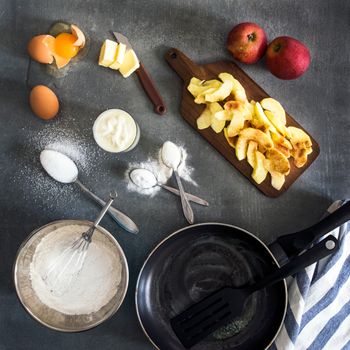 Digital kitchen scale
Weigh to the gram, the single most accurate way to bake.
Digital kitchen scale
Weigh to the gram, the single most accurate way to bake.
 Check price →
 Measuring cups & spoons
A solid stainless set for when a recipe calls for cups.
Check price →
Measuring cups & spoons
A solid stainless set for when a recipe calls for cups.
Check price →
 Glass measuring jug
Read millilitres and cups at a glance for liquids.
Check price →
Glass measuring jug
Read millilitres and cups at a glance for liquids.
Check price →
As an Amazon Associate, GramCups earns from qualifying purchases, at no extra cost to you.